

SATS
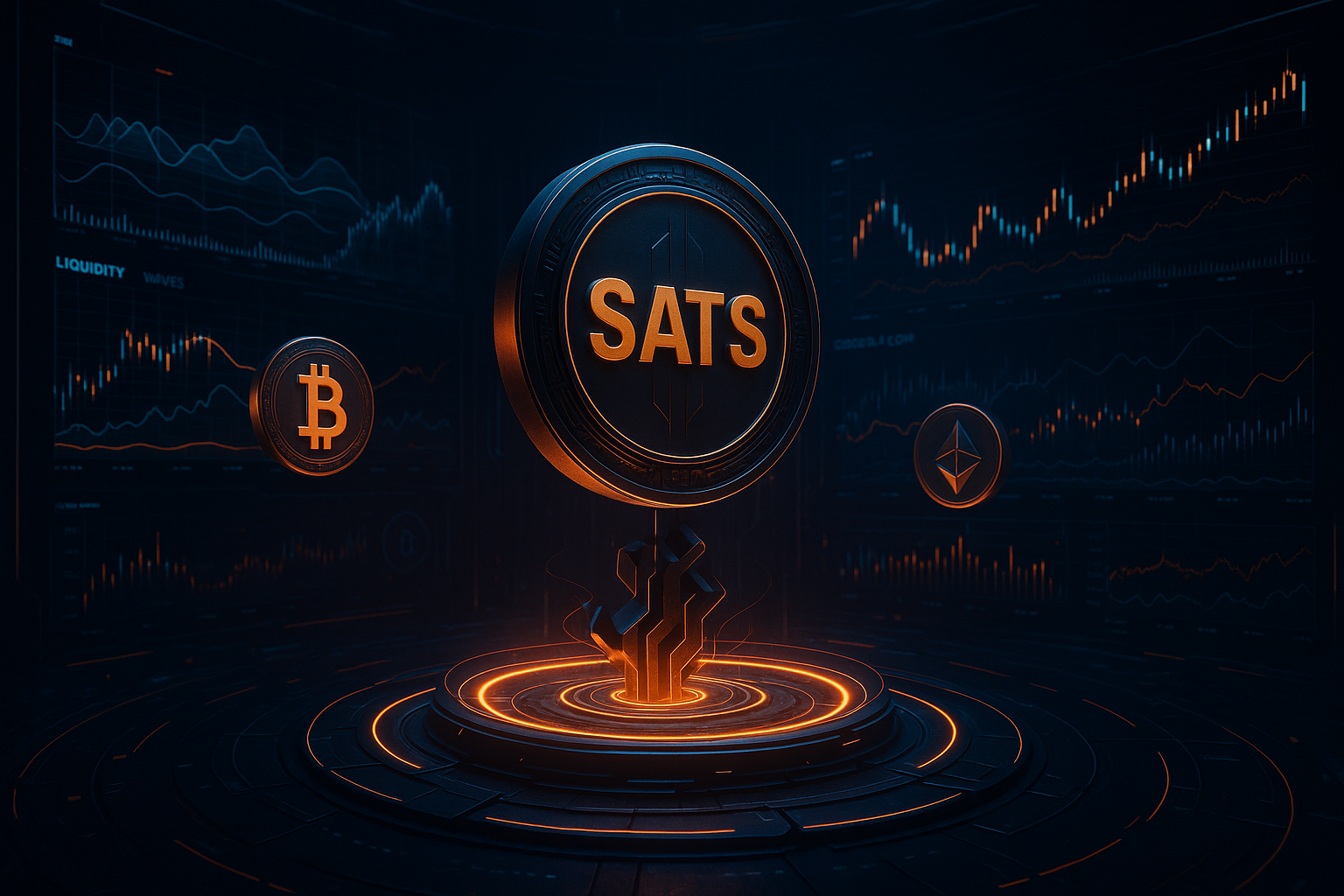
SATS is a “meme” or experimental token built on the BRC-20 standard, designed to highlight its connection to Bitcoin and its smallest unit. Issued by an anonymous team, it doesn’t feature complex smart contracts like Ethereum tokens, but instead focuses on symbolism and crypto-culture.
What backs it
From a backing perspective, SATS has several defining traits:
• It’s built on the Bitcoin blockchain via the Ordinals protocol, giving it a solid technical base – Bitcoin’s network security and the ability to embed data within UTXO outputs;
• It’s important to note, however, that SATS isn’t directly backed by any asset or reserve (such as fiat or Bitcoin itself). Its value depends primarily on demand and community trust rather than intrinsic collateral;
• Its symbolic link to “satoshis” (sats) makes it appealing to parts of the crypto community, yet it remains a high-risk, experimental asset.
Future outlook
Three scenarios seem plausible:
-
Positive: If interest in BRC-20 tokens and Bitcoin Ordinals continues to grow, SATS could attract more listings, liquidity, and mainstream recognition.
-
Limited: The token may remain a niche instrument within the community, lacking a clear utility function, with its price driven mainly by sentiment and speculation.
-
Negative: Should BRC-20 or Ordinals face technical or regulatory setbacks, or community interest fade, the token could fall into obscurity with elevated risk.
Key considerations
Traders and investors should remember that SATS isn’t a conventional asset with guaranteed returns or collateral – it’s an experimental token marked by high volatility.
Its current utility is limited: while it technically brings the concept of Bitcoin’s smallest unit into the BRC-20 format, there are no established use-cases yet.
The landscape is evolving fast – both Bitcoin’s blockchain and the Ordinals ecosystem are still developing, with competing standards emerging.
Ultimately, SATS is interesting as a cultural and technical phenomenon. It underscores the symbolic importance of Bitcoin’s smallest unit, showcases the potential of BRC-20 tokenisation, and demonstrates that Bitcoin’s network can be used for more than just transferring BTC. Yet its intrinsic backing and practical use remain minimal, and its future depends on ecosystem growth and community adoption. Engaging with SATS requires looking beyond hype to assess the genuine technological, legal, and market risks involved.
Category news: Assets (BTC / ETH / Altcoins / Commodities / Indices)
-
DOT
DOT is the native token of the Polkadot ecosystem – a next-generation blockchain designed to unite multiple independent networks into a single decentralised infrastructure. Unlike traditional cryptocurrencies, which operate within a single blockchain, Polkadot enables different networks to interact with one another, exchange data and resources, without sacrificing security or speed. DOT plays a central […]
-

DOGE
Dogecoin, or simply DOGE, is one of the most recognizable cryptocurrencies born out of internet culture. It was originally created as a joke – a parody of the hype surrounding Bitcoin at the time. Yet over the years, the coin evolved into a full-fledged digital asset supported by a large and highly engaged community. Its […]
-

COMP
COMP is the native token of the Compound protocol – one of the core services in the DeFi ecosystem operating on the Ethereum blockchain. Its primary purpose is protocol governance. COMP holders gain the right to participate in votes, submit proposals, modify system parameters, and influence the strategic direction of the project. In this sense, […]
-
ADA
ADA is the native token of the Cardano blockchain, a network designed as a research-driven platform for developing decentralized applications and smart contracts. The project stands out from others by relying on rigorous academic studies, formal verification methods, and a multi-layered architecture. The ADA token not only acts as a medium of exchange but also […]
Latest news
-
What is an AI crypto trading bot and how does it work?
An AI crypto trading bot combines analytics with automated execution, helping traders identify potential setups faster and, when needed, open or close trades according to predefined logic. On B-World, this works through AI signals and API trading: the platform receives market data and places orders via API keys created by the user on the exchange, […]
-

Manual trading vs automated trading: when is each more effective?
Manual trading tends to work best where context matters most: news flow, shifts in market regime, unusual situations, and the ability to “read” price behaviour. Automated trading, by contrast, excels in discipline and speed – strict rule execution, emotion-free decisions, and 24/7 monitoring. In practice, a hybrid approach often delivers the best results: you make […]
-
Is B-World suitable for beginner traders?
Expert Overview of the Platform’s Capabilities The crypto and forex trading markets are evolving at a rapid pace, yet for newcomers they can still feel overwhelming: analytics, risk management, strategy selection, and technical setup often create a significant barrier to entry. That’s why automation tools and trading-signal services like B-World are increasingly seen as a […]
-
Complete Guide to Automated Trading via API
Automated trading via API is a way to connect a trading platform to a cryptocurrency exchange so that trades are opened and closed automatically according to predefined logic, without manual involvement and without granting access to funds. On B-World, the API is used to retrieve data and place orders, while risk control and strategy management […]