

Manual trading vs automated trading: when is each more effective?
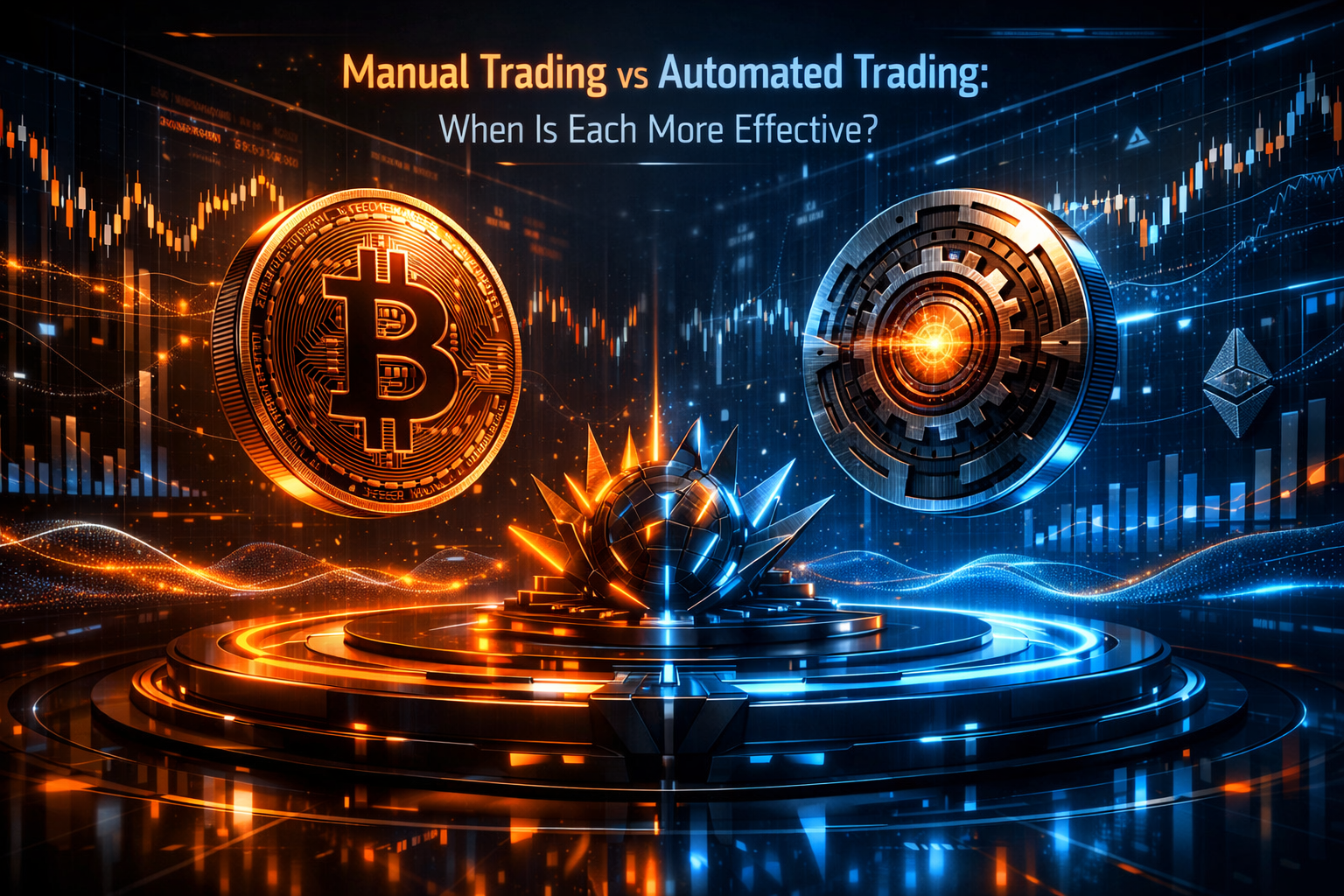
Manual trading tends to work best where context matters most: news flow, shifts in market regime, unusual situations, and the ability to “read” price behaviour. Automated trading, by contrast, excels in discipline and speed – strict rule execution, emotion-free decisions, and 24/7 monitoring. In practice, a hybrid approach often delivers the best results: you make the key decisions while execution and routine tasks are delegated via API trading.
Why “manual vs bot” is less about technology and more about control
Most debates get stuck in a false either-or. In reality, the choice isn’t “human versus algorithm” but how much involvement you want at each stage: analysis → decision → execution → risk control → post-trade review.
B-World is a trading analytics service: it provides access to signals and helps set up automated execution on exchanges via API keys that you generate on the exchange side. Strategy oversight and risk management remain with the user – a core principle reflected in the platform’s documentation and security approach.
When manual trading is genuinely more effective
Manual trading tends to make sense if you:
- Trade context rather than rules alone. Macro events, regulatory announcements, volatility spikes, or structural market shifts often require interpretation rather than mechanical execution.
- Focus on fewer but higher-quality setups. If trades are selective and heavily dependent on market structure and confirmation, manual execution can produce cleaner entries.
- Are still learning or refining your own system. Manual trading builds market awareness and helps clarify why you enter trades – an essential step before formalising rules.
Using B-World manually: treat AI signals as scenario ideas and an attention filter, but keep the final decision yours. That cuts noise and saves time without sacrificing control.
When automated trading has the edge
Automation tends to outperform manual trading where consistency is critical:
- Discipline and emotional neutrality. Algorithms don’t second-guess themselves, trade out of fear, or break rules under pressure.
- Execution speed and routine tasks. Condition checks, order placement, and reaction to triggers are typically faster and more consistent when automated.
- 24/7 market coverage. Crypto markets never close, and automation helps avoid missed opportunities while you’re offline.
On B-World, automation works through API integration: the service retrieves data and places orders on the exchange, while permissions are defined by the API keys you control. A key security practice is restricting withdrawal rights – something always worth implementing.
The most effective approach for many EU traders: hybrid
In real trading, extremes rarely win – balanced workflows do:
-
the trader interprets context, selects market regimes, and defines risk rules;
-
the system handles execution and monitoring;
-
signals help identify opportunities without endless chart watching.
This combination reduces typical mistakes: emotional entries, missed stop logic, screen fatigue, or delayed execution.
Quick checklist: what suits you best
Manual trading may fit if:
-
you trade news, structure, or context and prefer hands-on decisions;
-
trade frequency is low but selectivity is high;
-
you’re developing your own system.
Automated trading may fit if:
-
your strategy is rule-based and discipline-driven;
-
you want round-the-clock execution with less emotional interference;
-
you’re comfortable monitoring risk parameters regularly.
Hybrid may fit if:
-
you want control without the routine workload;
-
you value the balance of machine speed and trader judgement.
Summary
Manual trading is stronger in contextual and unusual market conditions. Automation excels in discipline, speed, and 24/7 execution. In practice, a hybrid model often works best: AI signals for identifying opportunities combined with API-driven execution – while personal risk control remains essential. B-World provides infrastructure for both approaches, offering signals and automated order placement via exchange-generated API keys, without promises or guarantees of results.
Category news: Markets and Instruments Product and Bot Features
-

What is an AI crypto trading bot and how does it work?
An AI crypto trading bot combines analytics with automated execution, helping traders identify potential setups faster and, when needed, open or close trades according to predefined logic. On B-World, this works through AI signals and API trading: the platform receives market data and places orders via API keys created by the user on the exchange, […]
-

Is B-World suitable for beginner traders?
Expert Overview of the Platform’s Capabilities The crypto and forex trading markets are evolving at a rapid pace, yet for newcomers they can still feel overwhelming: analytics, risk management, strategy selection, and technical setup often create a significant barrier to entry. That’s why automation tools and trading-signal services like B-World are increasingly seen as a […]
-

Complete Guide to Automated Trading via API
Automated trading via API is a way to connect a trading platform to a cryptocurrency exchange so that trades are opened and closed automatically according to predefined logic, without manual involvement and without granting access to funds. On B-World, the API is used to retrieve data and place orders, while risk control and strategy management […]
-

Bot that trades on an exchange
A trading bot is a program capable of automatically analysing the market and executing trades based on predefined algorithms. This technology is reshaping the traditional perception of trading and makes it possible to generate income even for those without deep knowledge of economics. Developing and using such a bot requires not only technical skills but […]
Latest news
-
What is an AI crypto trading bot and how does it work?
An AI crypto trading bot combines analytics with automated execution, helping traders identify potential setups faster and, when needed, open or close trades according to predefined logic. On B-World, this works through AI signals and API trading: the platform receives market data and places orders via API keys created by the user on the exchange, […]
-
Manual trading vs automated trading: when is each more effective?
Manual trading tends to work best where context matters most: news flow, shifts in market regime, unusual situations, and the ability to “read” price behaviour. Automated trading, by contrast, excels in discipline and speed – strict rule execution, emotion-free decisions, and 24/7 monitoring. In practice, a hybrid approach often delivers the best results: you make […]
-
Is B-World suitable for beginner traders?
Expert Overview of the Platform’s Capabilities The crypto and forex trading markets are evolving at a rapid pace, yet for newcomers they can still feel overwhelming: analytics, risk management, strategy selection, and technical setup often create a significant barrier to entry. That’s why automation tools and trading-signal services like B-World are increasingly seen as a […]
-
Complete Guide to Automated Trading via API
Automated trading via API is a way to connect a trading platform to a cryptocurrency exchange so that trades are opened and closed automatically according to predefined logic, without manual involvement and without granting access to funds. On B-World, the API is used to retrieve data and place orders, while risk control and strategy management […]