

How does a trading bot work?
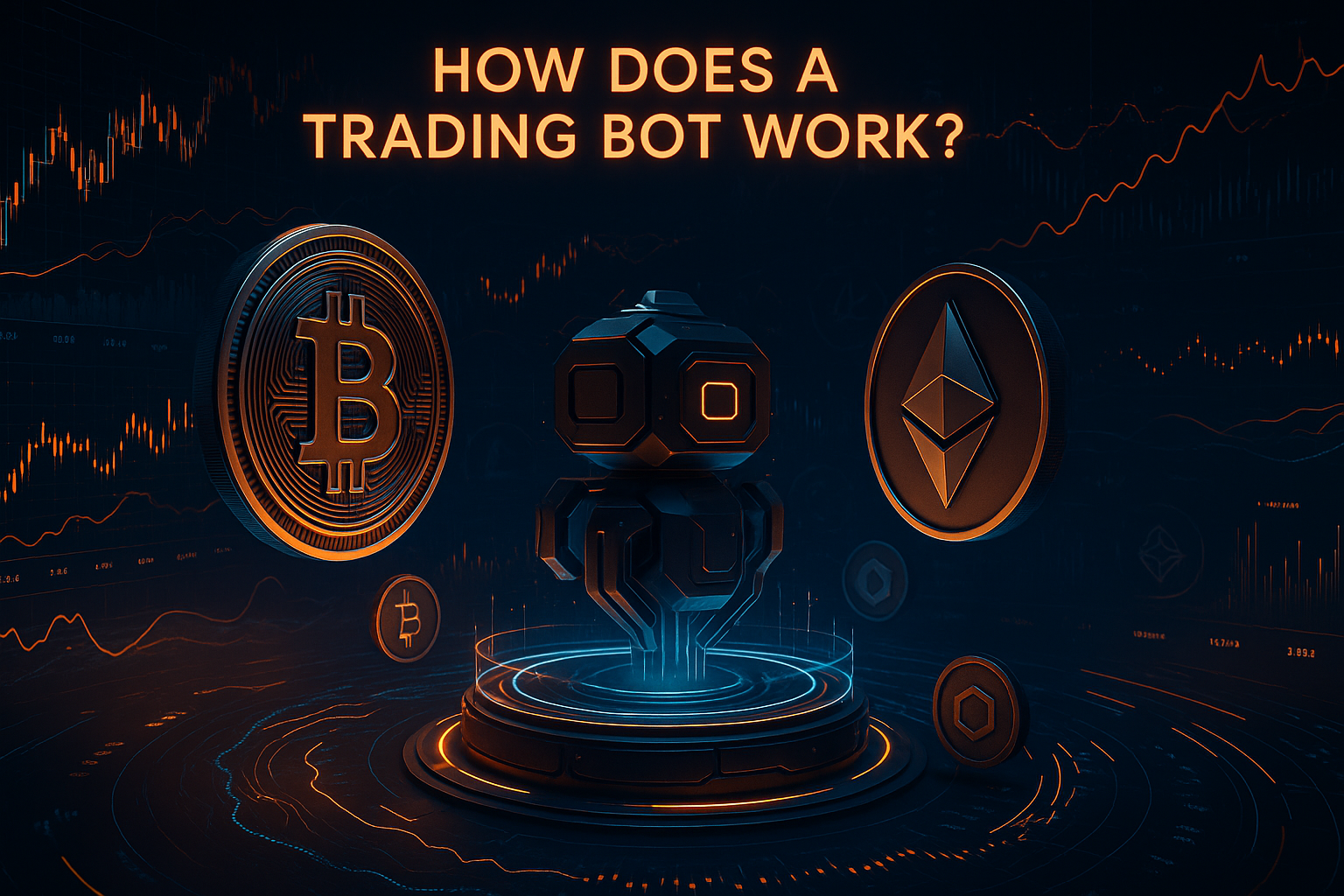
Today, technology is developing at a rapid pace, and more and more processes in our lives are becoming automated. This is especially noticeable in the financial world. Increasingly, people trust trading on the stock exchange not just to themselves, but to specialised programmes – trading bots. But how exactly does this modern assistant work? Let’s try to figure it out.
A trading bot is a programme designed for automatically executing trades on the financial market. It operates based on pre-set algorithms, analysing data and making decisions without human intervention. At its core, a bot combines mathematics, logic, and artificial intelligence.
The operation of a trading bot begins with data collection. It connects to the exchange and receives information about prices, trading volumes, trends, and other indicators. This data updates every second, and the bot reacts instantly to any changes.
The next stage is analysis. Depending on its configuration, the bot may use simple strategies, such as buying on price dips and selling during growth, or complex methods based on technical indicators and machine learning. Some bots even take news and the behaviour of other market participants into account.
After the analysis, the bot makes a decision – to buy, sell, or wait. This decision isn’t based on intuition like a human’s, but on precisely defined rules. For example, if the price drops below a certain level, the bot buys the asset; if it rises above, it sells.
Furthermore, the trading bot is capable of risk management. It can set stop-loss orders (to limit losses) and take-profit levels (to lock in gains). This helps protect the capital from unexpected market fluctuations.
It’s also important to note that the bot works constantly. It doesn’t get tired, distracted, or emotional. Its task is to execute the algorithm accurately and quickly, without straying from the plan.
However, despite all the advantages, a bot is simply a tool. It cannot predict the future or guarantee profits. Everything depends on how well it is configured and how often its strategy adapts to changing market conditions.
In conclusion, a trading bot is a smart executor that helps individuals manage their finances more effectively. It quickly processes information, precisely follows commands, and works tirelessly. But for it to truly be beneficial, it’s crucial to understand how it works and to keep an eye on its performance.
Category news: Product and Bot Features Trading Strategies
-

What is an AI crypto trading bot and how does it work?
An AI crypto trading bot combines analytics with automated execution, helping traders identify potential setups faster and, when needed, open or close trades according to predefined logic. On B-World, this works through AI signals and API trading: the platform receives market data and places orders via API keys created by the user on the exchange, […]
-
Manual trading vs automated trading: when is each more effective?
Manual trading tends to work best where context matters most: news flow, shifts in market regime, unusual situations, and the ability to “read” price behaviour. Automated trading, by contrast, excels in discipline and speed – strict rule execution, emotion-free decisions, and 24/7 monitoring. In practice, a hybrid approach often delivers the best results: you make […]
-

Is B-World suitable for beginner traders?
Expert Overview of the Platform’s Capabilities The crypto and forex trading markets are evolving at a rapid pace, yet for newcomers they can still feel overwhelming: analytics, risk management, strategy selection, and technical setup often create a significant barrier to entry. That’s why automation tools and trading-signal services like B-World are increasingly seen as a […]
-

Complete Guide to Automated Trading via API
Automated trading via API is a way to connect a trading platform to a cryptocurrency exchange so that trades are opened and closed automatically according to predefined logic, without manual involvement and without granting access to funds. On B-World, the API is used to retrieve data and place orders, while risk control and strategy management […]
Latest news
-
What is an AI crypto trading bot and how does it work?
An AI crypto trading bot combines analytics with automated execution, helping traders identify potential setups faster and, when needed, open or close trades according to predefined logic. On B-World, this works through AI signals and API trading: the platform receives market data and places orders via API keys created by the user on the exchange, […]
-
Manual trading vs automated trading: when is each more effective?
Manual trading tends to work best where context matters most: news flow, shifts in market regime, unusual situations, and the ability to “read” price behaviour. Automated trading, by contrast, excels in discipline and speed – strict rule execution, emotion-free decisions, and 24/7 monitoring. In practice, a hybrid approach often delivers the best results: you make […]
-
Is B-World suitable for beginner traders?
Expert Overview of the Platform’s Capabilities The crypto and forex trading markets are evolving at a rapid pace, yet for newcomers they can still feel overwhelming: analytics, risk management, strategy selection, and technical setup often create a significant barrier to entry. That’s why automation tools and trading-signal services like B-World are increasingly seen as a […]
-
Complete Guide to Automated Trading via API
Automated trading via API is a way to connect a trading platform to a cryptocurrency exchange so that trades are opened and closed automatically according to predefined logic, without manual involvement and without granting access to funds. On B-World, the API is used to retrieve data and place orders, while risk control and strategy management […]